

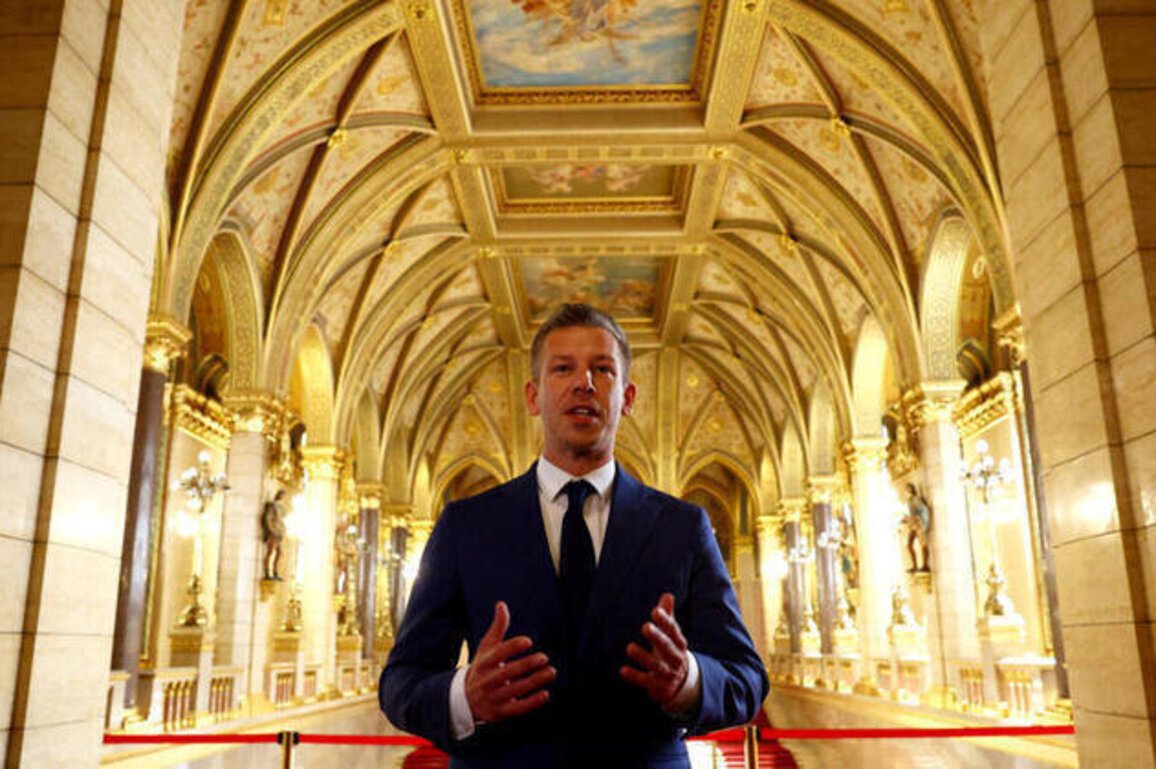
Following Viktor Orbans election defeat on April 12, new Hungarian premierPeter Magyarhas promised to seekjustice for crimes committed by his predecessor's network of political allies and the oligarchs who supported them.
The corruption is well entrenched: Orban dominated Hungarian politics for years without any serious challenger, and there has never been another figure in the countrys modern history who amassed so much power in such a relatively short period of time.
From the media to the judicial system and from universities to local governments, Orbans empire infiltrated every state institution. Nothing could be done inHungarywithout political connections, one of Hungarys wealthiest businessman told thePolish newspaper Gazeta Wyborczain April, while asking to remain anonymous.
Magyars centre-right Tisza party won 141 seats in parliament out of 199 in the April elections, giving it a large majority to strengthen therule of lawandpotentially unlock billions in fundingfrom theEuropean Union, which froze the allocation under Orban due to concerns over corruption and democratic backsliding.
Yet time is of the essence: Magyar has warned that oligarchs allied with Orbanhave begun siphoning off assetsto the United States, the United Arab Emirates, Uruguay and "other distant countries.
The Polish experience could provide some insight into what options exist for Hungary. After a liberal opposition bloc led byDonald Tuskcame out ahead in October 2023 parliamentary elections, Tusk pledged as prime minister to reform Polands institutions following eight years of right-wing Law and Justice (PiS) party rule. He immediately fired high-profile figures and bypassed some of the legal obstacles left by the previous government.
FRANCE 24 spoke with Balint Magyara sociologist, former education minister and author of the book, The Hungarian Octopus: The Post-Communist Mafia State who argues that Hungary is embarking on not just a change of government, but a full-on regime change.
Magyar has promised to go after corrupt officials who were part of the so-called Orban system. Does he risk falling into the very illiberalism he pledged to abolish in seeking a rupture from the Orban years?
Peter Magyarwon 53% of the votes in the elections on April 12, which gives him a more than two-thirds majority in the parliament. It meant that Orbansattempts to make election lawmore disproportionate backfired. Such a constitutional majority is enough to change any law.
Among Magyars promises during the elections was instituting a proportional electoral system. The incoming premier has also promised to limit the maximum time for future prime ministers to two terms eight years total.
What happened was not a government change but a regime change. A government change means that basic values are shared by the competing parties. In a regime, the competing parties do not share the same political values.
Hungarians witnessed the first regime change in 1990 from a communist dictatorship to a liberal democracy.
The second regime change happened in 2010, from a liberal democracy to an autocracy. This is what Orban called a revolution at the ballot boxes. In 2011, he rushed a new constitution through the parliament without any consultation with the public (called theFundamental Law of Hungary, the new constitution codified a new interpretation of history andethno-nationalist principles).
Magyars victory represents the third regime change in Hungarys recent history, from an autocracy hopefully back to a liberal democracy. The incoming premier has pledged to hold a referendum on accepting a new constitution.
How difficult will it be to prosecute high-placed officials like Peter Szijjarto, the minister of foreign affairs and trade, who reportedlyleaked informationon EU summit discussions to Russia?
Looking to turn the page on Orbans tenure, Magyar has pledged to pursue officials and corporate leaders accused of corruption: during his campaign, he launched a programme called Road to Prison. This was not an ordinary type of corruption. If you look at the international scene, you can see charges brought againstPoland's former deputy minister of justice in the Law and Justice government, Marcin Romanowski, or against Romanian politicians. These are minor cases compared to the scale of robbery of the state committed by the Orban clans politicians and oligarchs.
The Fidesz government operated like a mafia state. All contributing members of society were subordinated to it: it was a political enterprise which captured the state, the economy and the oligarchs. The mafia state had two motivations: monopolising political power and accumulating personal and family wealth. With the possibility of unilaterally appointing the heads of the controlling organisations and the presidents of the republic, central bank, constitutional court, chief attorneys office and state account office, Orban could exercise direct coercion and blackmail over the whole society. As all these figures were subordinated to Orban, he could govern the state as a criminal organisation. Most of these actors and Orban-related oligarchs committed crimes, according to existing Hungarian legal code.
Magyar has called on all the leaders of the above-mentioned institutions to resign. If they dont comply, he will use legal means to oust them from their positions.
Police have already begun investigations even though Magyars government isnt in office yet. I dont think rank-and-file loyalists will be prosecuted. What we will witness is the total collapse of the mafia-state organisation led by Orban.
Also, the difference between the Hungarian and Polish cases is that the Polish leader of the PiS party, Jaroslaw Kacznyski, was an autocrat but not a criminal, while Orban was an autocrat and a criminal at the same time.
There will be widespread legal procedures, although I have some doubt that stolen state assets will be recouped. (Wealthy Hungarians are leaving the country and transferring financial assets,according to the Financial Times.)
Orban has been voted out, but he once famously said in an interview with an Austrian tabloid that he "would like to tie the hands of the next government. And not only of the next, but of the following 10 governments." How big of a threat does he andFidesz present to the incoming government?
Orbans defeat in the latest elections represents not only a political, but a total moral collapse. There is a difference between a mafia state and a classic mafia. The positions within a classic mafia are informal positions: they can bribe public servants if needed, but they mainly operate outside the governmental bodies.
In the case of the mafia state, the positions are positioned within the state apparatus. After winning a constitutional majority, Magyars centre-right Tisza party can take back these political and administrative positions. Orbans political-economic clan, therefore, faces an unavoidable collapse.
A national opinion poll published this week asked Hungarians for the main reason for Orbans defeat. Some 49% responded that it was corruption, around 18% responded that it was the bad economic situation, and around 10% attributed the defeat to the lies of the government. This represents the dual nature of wide popular discontent: namely, the complete amorality and incapacity of Orbans regime.
This interview has been lightly edited for length and clarity.
Originally published on France24